



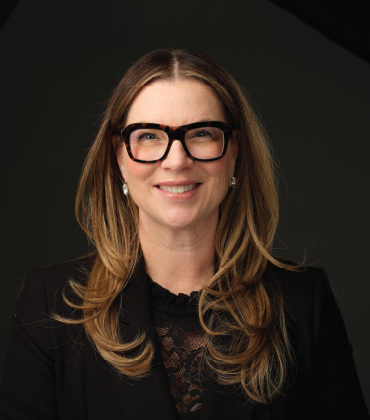
 Marjorie Poitras, MBA, PCC, Founder and President
“We don’t need more leaders with titles—we need leaders with posture. Leadership effectiveness is not defined by title or competencies, but by the ability to take responsibility and shape meaningful impact within a system,” says Marjorie Poitras, executive coach and leadership advisor with more than three decades of organizational experience.
Titles may confer authority, but Marjorie believes leadership development cannot end with skills or performance habits. It has to reach the deeper human level where leaders recalibrate their posture and act with purpose and intent.
Across industries and seniority levels, Marjorie observes that executives are not constrained by a lack of capability, but by the growing complexity of their environment—competing priorities, systemic tensions, ambiguity and decisions with far-reaching impact on both performance and people.
Marjorie highlights that in these moments, leadership is not developed through training or tools alone, but through deeper shifts in awareness and posture.
“What they call for is space and perspective to recenter, recalibrate their mindset, reconnect and balance with their strengths and think clearly again,” she explains. “It also means challenging themselves to move beyond their reflexes, habits and the methods that made them successful in the first place.”
At that intersection, Marjorie has built OZHEO’s coaching practice on a simple but demanding principle: “We don’t coach a role, we coach a person.”
The work walks alongside leaders, partnering with them as they evolve personally, relationally, strategically and systemically. By going beyond executive polish or surface-level leadership practices, OZHEO addresses the deeper drivers of leadership, including mindset, values, posture, self-awareness, blind spots and strengths. It explores how leaders create conditions for success in their context. The emphasis aligns with who a leader is, how they decide, how they relate to situations and the impact they create.
Marjorie calls it ‘Next Level Coaching’ because it changes not just what leaders do, but how they show up and lead. It is where humanity meets sustainable performance and where existing strengths become the foundation for new leadership chapters.
A Framework for Leadership Work that Holds
How does OZHEO structure its coaching model to support sustained leadership transformation and accountability?
OZHEO’s coaching model rests on four pillars.
The first is partnership. It begins with the relationship between the coach and the coachee—building trust, creating a safe and confidential space and establishing the foundation for honest reflection and meaningful growth. From there, coaching at OZHEO extends into a three-way partnership between the coachee, the coach and the organization—typically the direct manager and, at times, a designated sponsor. This structure creates clarity, strengthens accountability and ensures development remains closely aligned with both individual growth and organizational priorities, anchoring leadership development in both personal transformation and business relevance.
Marjorie has built OZHEO’s coaching practice on a simple but demanding principle: “We don’t coach a role; we coach a person.
The third pillar is action. Coaching conversations can create clarity, but progress depends on turning that clarity into behavior in the leader’s operating environment. Between sessions, leaders are encouraged to test new approaches, observe results and refine their practice. Over time, that test-learn-refine cycle helps new leadership habits take hold.
Accountability comes next. Mindset and predisposition matter, and preparation is not treated as paperwork, but as intention. The client’s ownership of commitments is central to the process, reinforcing accountability for action and progress. Revisiting commitments in each session becomes a way to examine what worked, what did not and what needs to shift or evolve to reach the next level.
Where Urgency Gives Way to Intention
Why is shifting from reactive behavior to intentional leadership critical in complex executive environments?
“What matters most?” is one of the questions that helps leaders at OZHEO step back from urgency and reconnect with what their role truly requires. The work moves leaders from default mode to intentional leadership, from pressure-driven reactions to choices grounded in awareness, purpose and impact.
Marjorie sees five recurring movements.
In shifting immediacy to clarity, instead of reacting to urgency, leaders pause, assess what matters most and make more deliberate decisions – grounded in the time horizon aligned with their strategic demands of their role.
That leads to shifting from control to conscious influence, where authority-driven responses are replaced by alignment, credibility and stakeholder engagement.
From operational intensity to strategic focus prompts another shift. Leaders learn to balance execution with long-term direction, sustaining performance while strengthening forward-looking planning.
Shifting from self-orientation to collective leadership produces outcomes no longer carried alone but shared through distributed accountability and stronger team ownership.
The final shift is from habitual response to intentional action. Leaders begin to recognize patterns in how they react under pressure and adjust their behavior to better align with the outcomes they are responsible for creating.
-
Professional rigor is not a label to display, but a discipline that protects the integrity and impact of the work.
Marjorie describes the philosophy underpinning all five as the power of “AND,” trust and challenge, reflection and disciplined execution, decisiveness and openness, humanity and performance. Beneath these lived tensions lies a set of leadership movements: from immediacy to clarity, from control to influence, from execution to strategic focus, from individual ownership to collective leadership and from reactivity to intentional action.
“Strategic leadership is not about choosing between them - it is holding both at once,” adds Marjorie.
Turning Individual Insight into Collective Leadership
In what ways does OZHEO extend individual coaching into collective leadership and organizational change?
Individual growth has limits. Real organizational change happens when leadership teams evolve together. Peter Senge argues in The Fifth Discipline that change takes hold when people learn together and build a shared capacity to reflect on the systems in which they operate.
 Conversations with key stakeholders, alongside individual sessions, reveal the dynamics shaping a team, identify tensions and clarify the shifts most likely to move things forward. A customized pathway then unfolds over several months through three to five workshops interwoven with individual sessions.
OZHEO’s workshops are developmental experiences, not training sessions. There is no content expert at the front of the room. Instead, a facilitator creates the conditions for structured reflection, open dialogue, self-awareness and builds trust. The work is built around participants’ leadership tensions and business situations, not abstract models or hypothetical cases. In parallel, individual sessions give each person space to integrate what surfaces, refine executive presence and translate collective insight into behavior within their teams. Peer learning strengthens that process. Hearing another leader articulate a tension they have also been experiencing can move things forward faster than any framework alone.
For organizations seeking deeper continuity, OZHEO can extend the work through a strategic developmental presence, where the coach stays connected over time, helping leaders revisit situations, consolidate new habits and ensure insight does not slip back into old patterns.
The Discipline Behind the Practice
OZHEO’s team includes certified coaches with senior executive experience, including former CEOs, EVPs, SVPs and leaders from large, complex organizations. Firsthand experience in executive pressure and consequence brings immediate relevance and credibility to coaching conversations.
Professional supervision plays a central role in maintaining coaching quality and integrity. Coaches find a confidential space to reflect on their interventions, question their assumptions and deepen their awareness of the coaching relationship, all while protecting client confidentiality. That discipline strengthens presence, listening and ethical rigor.
“Professional rigor is not a label to display, but a discipline that protects the integrity and impact of the work,” says Marjorie.
A broad network of certified executive coaches allows OZHEO to match each client with the right coach for the leader, the context and the moment. Coaches continue to grow through advanced training, supervision, peer dialogue and reflective practice, keeping the coaching grounded, ethical and relevant. Better-developed coaches ask better questions, adapt more effectively and accelerate impact.
When Personal Overperformance Stops Being the Answer
One recent engagement involved a senior leader promoted to a broader mandate amid rising pressure. As demands intensified, the leader responded by taking on greater operational weight to protect performance. Intense commitment gradually created strain, narrowed strategic focus and limited the team’s ability to grow around the role.
The coaching created space for the leader to step back, examine assumptions and recognize the leadership model being unconsciously reinforced. The shift was not simply about reducing workload. It was about rethinking how responsibility was being held, where over-functioning had taken root and what conditions were being created for others.
The outcome impacted both people and the business. The leader built and scaled the function, expanded international opportunities and strengthened team readiness. More importantly, the leadership model evolved from personal overperformance to creating the conditions for collective performance and well-being.
Depth Over Scale
OZHEO’s 10th anniversary in 2026 reinforces its focus on depth, while expansion remains secondary. It is strengthening its national presence, building strategic partnerships and contributing to leadership development through frameworks, publications and public speaking.
A key milestone is Marjorie’s upcoming book, ‘Dare to Be Coached, Inside the Coaching Room,’ which brings together executive experiences from leaders who continue to apply coaching insights over time. The book reflects a consistent principle: leadership outcomes improve when decision-making and behavior evolve in practice.
Marjorie reflects that philosophy in lived form. She is a mother, MBA, PCC-certified coach and vice-president of ICF Québec, with fellow status in the financial sector and a long-distance runner’s view of development built through endurance, consistency and the willingness to stay the course.
Manage HR’s recognition of OZHEO as a Top Executive Coaching Firm in Canada 2026 reflects an approach built for leaders who want more than surface-level performance support. It speaks to a coaching practice that helps leaders deepen inner clarity, make more intentional and clearer decisions, strengthen stakeholder relationships and the broader ecosystem and lead more effectively in fast-evolving, high-stakes environments.
A piece of wisdom Marjorie shares from experience, “Leaders move from reacting to truly leading, from doing more to leading better. When leaders commit to the inner work, the outer impact follows and we are there with you in every step of this journey.”

